Rick Janson Art Studio

My Art Journal

  • Being present in the City of Light

    This is probably the worst sales pitch ever. The second painting of mine to be completed in 2026 has to be among the saddest I’ve ever done, although I have been thinking about it since I snapped a photo of two people in a Paris cafe who seemed to be totally absorbed in their cell phones.

    It was during a free day in the City of Light. I was determined to collect images that day which would provide fodder for my easel over the next few years. Most of those images tend to glorify the social aspect of the city, cafes filled with people interacting in that old-fashioned way: face to face. In an age of increased isolation and loneliness, walking around Paris appeared to be the anecdote to such affliction. I was also determined to visit many of the sites painted by the masters, filled with the idea that it would be interesting to revisit those sites and bring my own approach to the same subject matter a century or more later.

    It was still relatively early in the day when I passed this pair and their dog. The two were not in the present. The dog was. The cafe was in Le Marais, not far from the Pompidou Centre. I have no idea of whether they were French for foreign tourists, or whether they were even together. The way these cafes work it is often difficult to tell, which has the added bonus of throwing people together to interact with one another — something we definitely did during our time in Paris.

    I don’t mean to pass judgment — I think everyone wrestles with how much of their lives are controlled by their phones and somebody else could have just as easily stumbled across me doing the same. But it seemed particularly ironic in a city with as much life as Paris.

    According to a paper published by the Oxford University Press, there are two hypothesis regarding cell phones and loneliness. The Displacement Hypothesis suggests that nomophobia (an addiction to your cell phone) leads to loneliness, whereas the Compensatory Internet Use Theory suggests that people who are already lonely develop an addiction to their phones. The paper itself leaned more to the latter than the former.

    In the end, I ventured to capture that feeling of loneliness in the picture. I think it may have looked differently without the dog as contrast to what was going on.

    Social Time (2026) 16″ x 20″ Oil on Canvas

    In a recent interview with the New York Times, writer George Saunders speaks about Chekhov: “He says a work of art doesn’t have to solve a problem — it just has to formulate it correctly… (On Lincoln In The Bardo) I wrote myself into a place where the question got more and more profound, and I found myself less and less capable of giving a definitive answer. That’s not for an artist to do.”

    While technology has changed our lives and made things more convenient in many ways (remember when you used to have to line up hours early before a box office opened to get tickets to your favorite band?) the technology also changes us in many ways, perhaps something we are becoming increasingly aware of in an increasingly scary world. Saunders appears aware of this, noting that he’s as flawed as anyone else, “one who’s still wrestling with questions about how to best move through life with a modicum of grace and compassion.”

    I hope some of that ambivalence and searching comes through my painting.

    This painting will be on view and can be purchased January 28 to March 1, 2026 at the Leslie Grove Gallery Gallery, 1158 Queen St. E. in Toronto (at Jones). The painting is listed at $1200 CDN (including the black float frame it will be shown in). Most of my work is shown in non-commercial municipal galleries, so this is a chance to purchase directly from the Leslie Grove Gallery. Additional work will also be available for sale in May as part of the Scugog Studio Tour. More information on that to come.

    In recent days I have been working on a small painting of a carnival at night. I got a little flustered after a while, realizing I couldn’t replicate the colours of the rides with conventional oil paints. I went on-line and found that I could get neon colours in a alkyd resin oil paint that works with conventional oils. Those paints arrived this morning, and I’ll let you know how it went when I get back to that canvas (I rotate four or five works at a time). The alkyd apparently helps the paint to dry faster too, allowing one to layer more quickly.

    Meanwhile, don’t forget to a) subscribe (it’s free and I won’t fill your inbox with spam) and b) if your not into reading a bunch of words, you can skip ahead to my portfolio by clicking here.

  • The Peace

    I don’t really do pastoral images largely because it is not my lived experience. I’m an urban dweller, and most of the places I like to visit are urban. I decided almost immediately that I would paint this image not because of what was in front of me, but because of what was immediately behind me. They appear related.

    In 2002 we met up in the predawn hours near the Arc de Triomphe in Paris to take a tour of Juno Beach in Normandy, the battleground where the Canadian forces came ashore on D-Day. There were many people waiting for buses that morning in Paris on one of the spokes leading to the Arc, most of them Amercians headed for Omaha Beach. Only six of us boarded a passenger van headed for Juno.

    It was quiet that day, not a surprise given the reminder of the sacrifice these young men made to rid Europe of an axis of fascist regimes that had terrorized so many people. It was hard to imagine the noise of battle as they stormed ashore given all we could hear at the beach that day in 2022 was the wind and waves. Nearby there was a group of windsurfers preparing to go out.

    We visited the beach, saw what became known as “Canada House,” the first building captured by any Allied forces on D-Day. We saw the impressive museum erected by Canada and toured the remains of a German bunker. We took in one of the peaceful war cemeteries and shown the furthest point inland any Allied force had gotten to on that day — the Canadians achieve stealth and speed by bringing their bicycles.

    The last stop of the day was at the Abbaye d’Ardenne on the outskirts of Caen. When we got our of the van, the first thing I saw was this pastoral scene with the cows. When I turned I saw the Abbaye and a stone wall holding the pictures and names of 20 Canadian soldiers who had been executed at that spot by SS Colonel Kurt Meyer. According to Veteran’s Affairs, 156 Canadian prisoners had been executed by the 12th SS Panzer Division during the Normandy invasion.

    Meyer was eventually put on trial for his war crimes. He was sentenced to death, but that was commuted to life in prison. Meyer only served eight years before being released in 1954. He died seven years later. Our tour guide thought the Canadians were far too lenient with Meyer given what he had done.

    As unthinkable as this atrocity was, I kept drawing back to the cows, thinking perhaps this was the dividend for ridding Europe of fascism and all the fear that came with it. Despite being close to Caen, it was very quiet. It was what peace looked like. I couldn’t get it out of my mind.

    Normandy (2026) 16″ x 20″ Oil on Canvas

    Curiously, as the world experiences new war crimes, crimes against humanity and cases of genocide, the Trump administration is trying to undermine the International Criminal Court in the Hague by imposing steep sanctions on judges and prosecutors and urging countries to withdraw from participating with it. In today’s New York Times article on the Trump sanctions, they quote Kimberly Prost, a Canadian judge, who has been targeted by Washington’s sanctions on the Hague: “You lose immediate access to all the main credit cards that go through the Swift system, which is controlled by the US,” she said. “My Amazon and Google Accounts were closed. You cannot pay for your utilities, your subscriptions. You’re completely crippled when it comes to booking hotels, trains, flights. You can’t buy dollars because your name is flagged.”

    The US has never recognized the court, and last summer threatened legal penalties to two New York law professors in order to pressure them to abandon their association with the international court. At present the ICC has outstanding warrants for the arrest of Israeli Prime Minister Benjamin Netanyahu and Russian President Vladimir Putin. The trial of former Philippines strongman Rodrigo Duterte is about to begin soon, according to the Times.

    The generation that stormed the beaches of Normandy are few now, most having passed away. But the world now faces a new threat of fascism, not just in the US, but in countries throughout the world. Is this the end of the peace?

    Want to see more recent work by me? Click here.

  • Exhausting To Think About

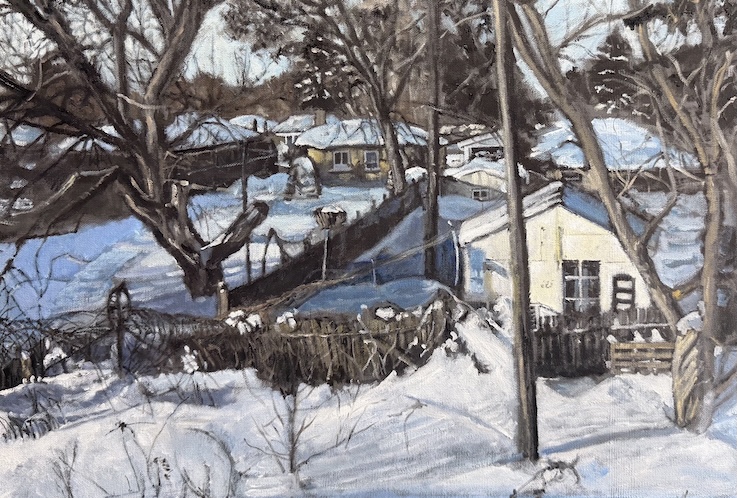
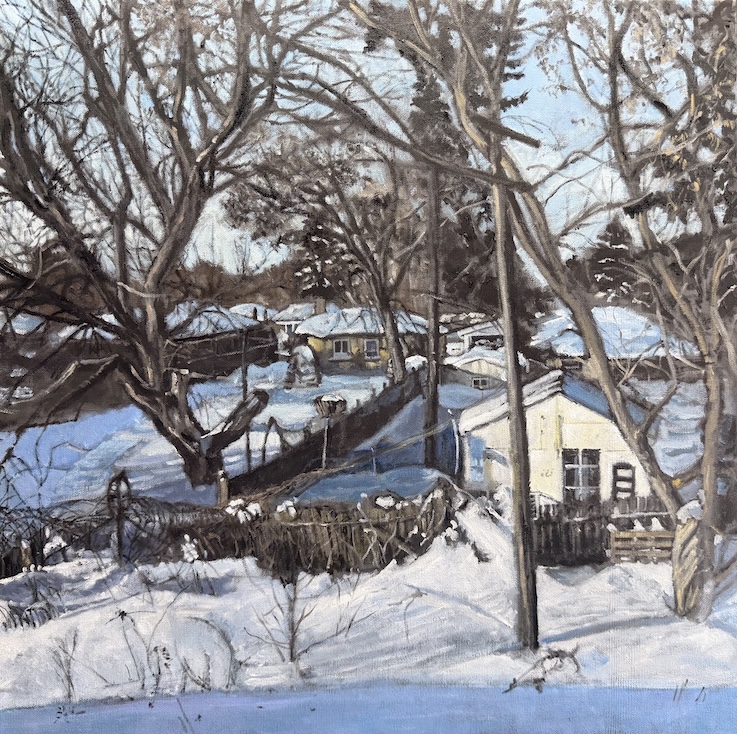
    I get tired just thinking about it. It’s about storms, both metaphorical and real. Instead of making art, I find myself spending hours clearing snow from around the house, and in between, prevent ice build-up during the times when the temperatures hover around zero. I also keep on wrestling with the idea of changing my narratives given the chaos of the world, but then again think that perhaps it might be time to escape all that and establish my own narratives?

    And in the midst of it all we just came through the holiday season. Maintaining traditions means for us bringing down bins of material from the attic to decorate the house — a process that takes about five days. We return the emptied bins to the attic only to bring them down again after New Year to carefully pack everything up again. Thankfully that’s a much shorter period — two days. A recent tradition has involved a lighted Christmas village we have built up over many years. Each year I place a Batman figurine in there, and the grandkids try and find him — kind of a Where’s Waldo moment. This year Batman was buying a taco at the food truck, helping out at the tree lot, warming himself beside Santa at a campfire, and surveying the city atop the cathedral.

    Amid all the craziness in the world, I was stunned to read that the Pompidou Centre in Paris was closing its doors for the next five years. Opened in 1977, it is undergoing a second round of renovations, the first done in the late 1990s.

    For those not familiar with the Centre, it houses the world’s second largest museum of modern art, a large reference library, a cinema and a music and acoustics research centre. It draws about five million visitors a year to its Paris location in the Marais, although the Pompidou also has a series of satellite locations across the world, including in Brazil, China, Spain and Belgium. None yet for Canada, sadly.

    The Pompidou has a collection of nearly 120,000 items, some of which will go into storage, others distributed to these satellites during the five-year renovation process. As a December 21 New York Times article noted, it took the Louvre three days to pack up and move 4,000 “national treasures” to safety prior to World War II. It’s anticipated that one single exhibit at the Pompidou will take closer to five weeks to pack up — Le magasin de Ben — which was an actual record and camera shop in Nice prior to being moved to the Pompidou Centre in 1974.

    When I visited the Pompidou in 2022, I was captivated by it. Ben Vautier had made his shop a hang out for the art community in Nice, constantly adding found objects to the display and encouraging the participation of those who frequented the shop. The shop itself became a piece of art. When it came to the Pompidou, it was accompanied by a 300-page manual on how to reassemble it on site. The conservators are now using that manual to disassemble it as well as undertake restoration on artifacts within the shop — no doubt some were never intended to last this long. That includes photographing every little bit of it.

    Le magasin de Ben (1958-1973) Mixed Media. It was installed at the Pompidou Centre prior to its opening in 1977.

    Curiously, while our travelling companions in 2022 were eager to get to the Musee D’Orsay, I spend the day alone at the Pompidou, which meant I could view the gallery at my own pace and felt little responsibility to the others in our party as a result. While I lament the lack of popular interest in modern art, the Pompidou still receives nearly five million visitors a year.

    The collection is an incredible survey of the development of art in the 20th century and is very international in scope. You’ll get to see a Dubuffet in one room, a Pollock in another.

    I get tired thinking about what a task it would be to pack up so many art items, not to mention an entire library of books on the lower level, some of which will go to an alternate location in Paris. And when the renovation is done — the Pompidou plans to reopen in 2030 — all this has to be put back again.

    Jardin D’Hiver (1969-70) by Jean Dubuffet.

    The Pompidou was the center of controversy when it first opened. The design competition was awarded to two young architects — Richard Rogers and Renzo Piano — who seemed equally shocked that their radical “inside-out” design had won the competition. All the technical functions of the building that are normally hidden were featured on the outside, colour-coded to their function. Like the Eiffel Tower, it was initially derided by the press, but Parisians came to love the building over time.

    While under renovation the building will celebrate its 50th year in 2027.

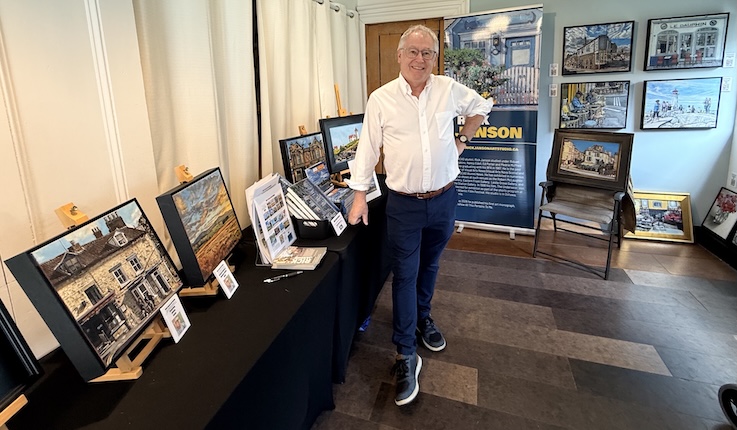
    It has been a busy time for me — I have been working hard at completing some work to enter into another juried show in Toronto next month. Deadline is this weekend. I’ve also been gathering quotes for an art book I hope to have ready by the time of the Scugog Studio Tour in May. The book would be an introduction to my work and highlight some of the newer pieces to come out of my “art hut.” I started writing it more than a year ago — the difficulty is choosing when to put a cap on the work I would like to see in it. You always think the next piece is going to be the truly great one — the “just one more” syndrome. I currently have a piece on show in the Rare Form group show at the Station Gallery in Whitby. I also started to work on some smaller pieces that I hope would be more affordable for the Studio Tour in May. Hopefully in the next day or two I will have a new piece (or possibly) two up on this site. I tend to work on multiple pieces at a time, so it can sometimes be a long time between new works, then they seem to arrive in a flurry. Of the four pieces I have on the go, the one I am struggling with is the most experimental of the lot. While many of my pieces involve travel, this one actually travels back in time. It is taking shape, but the lack of clear references for it does make it a challenge.

  • A comeback for contemporary painting?

    The year I graduated from Art School, the art world was in one of its “painting is dead” moments in 1987. It had been three years since New York’s Museum of Modern Art (MOMA) had last held an exhibition of contemporary painting – MOMA having included my professor among the world’s 100 most promising painters. One of the pre-eminent gatekeepers of modern art, it would not stage another for 25 years. That alone speaks volumes of the world I stepped into as a painter. Any wonder I made my living elsewhere for the last 40 years?

    Painting appears to be making a comeback these days, not that it entirely went away. It was kept alive not by curators of contemporary art, but by collectors and members of the public who refused to turn their backs to it. Painting continues to be well-represented at the international art fairs, where booths are expensive and the ability to actually sell something and collect commission is necessary to cover those costs. Declaring painting dead likely didn’t help.

    Wednesday night my spouse and I attended the opening of Rare Form at the Station Gallery in Whitby. The Station Gallery is one of the many small municipally-run non-commercial galleries that offer a lifeline to local emerging artists who are seeking to develop an exhibition record and get their work in front of the public. Rare Form is the 33rd Annual community exhibition, drawing in so many people on its opening night that it was uncomfortable. Some people (not us) were wise enough to wear surgical masks amid a particularly bad flu season.

    We were told that there were 200 applicants to the show’s call for entry, of which it appears about 150 made the exhibition. That led to some very crowded spaces – the Station Gallery has only three modest-sized salons on its main floor. I felt badly for anyone who was hung in the corridor between the last two galleries – it was next to impossible to look at the work there amid all the people coming and going. My painting was hung in the second gallery, just above a fire alarm, the bartender kidding me that my painting must have been hot stuff. At least I made a wall space — others were shown on easels. As much as I admire their attempt to be as inclusive as possible, the jury should have likely tried a little harder to move the number of selections downwards. Quality over quantity. I think that most artists would prefer it that way too. Of course, amid a crowd like that it is also impossible to properly take in the show.

    As a point of comparison, I recently applied to the Think Pink show at the Leslie Grove Gallery (starting January 7th). I didn’t make the cut, but neither did three of four applicants. They too had more than 200 submissions and limited their selection to 54. The last colour-theme show I had participated in with this group was 2006, then at the Eastern Front Gallery. I was fortunate to be among the small number who were selected back then for the Blue Show. My turn will come around.

    While paintings likely dominated submissions (I didn’t count) in Whitby, none of them made the top three awards on the evening, the prizes going to a ceramic piece (three mugs attached together with a ceramic chain), an abstract(?) fabric piece, and a small sculpture assembly that looked a little goth or new age to me. Amid the crowds, I was worried that the ceramic piece was most at risk: I noticed one woman narrowly missed knocking it off its plinth with her handbag while squeezing past other patrons.

    My spouse also noted the lack of landscapes among the selected work. She did like one landscape made of felt, and there were some landscape photos, but there wasn’t a lot overall. This in a country predominantly known for its natural vistas. Are we finally past the Group of Seven? Maybe? On-line it would be hard to make that argument given all the Group of Seven wannabes posting their rocks, trees and lakes with zeal. Maybe landscape artists know better than to enter competitions? Coincidentally this morning’s Art Net post noted the comeback in landscapes, with of course, a modern twist around story telling. That trend may be a little slow to get out to us in the burbs.

    At the beginning of the 19th Century landscape was considered to be the lowest form of art, many believing that artists did little more than go out in nature and copy what they saw, compared to, for example, history painters. That all changed and got supercharged with artists like Corot and later the French Impressionists. In Canada we had the aforementioned Group of Seven. But then the rest of the 20th Century was not particularly kind to landscape, and I feel we have somehow gone back 200 years.

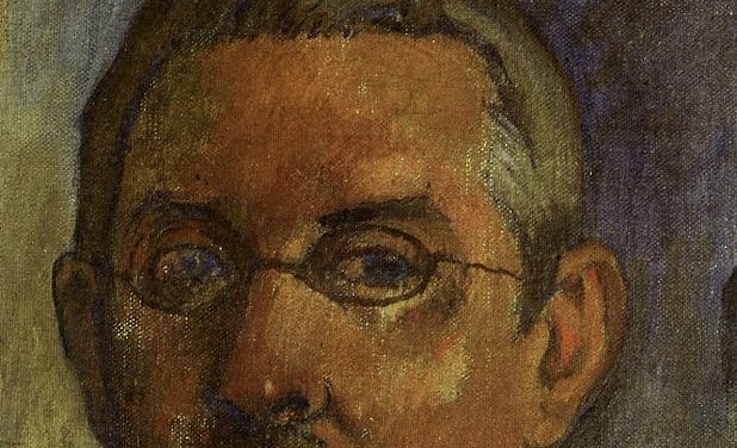
    Funniest moment on Wednesday night: A fellow artist who likely knew me from the Oshawa Art Association asked which piece in the show was mine? I said it was the self-portrait on the wall above the fire alarm. “Who’s it of?” she asked before realizing her faux pas and laughing.

    I also noticed this week that the Estate of singer Marianne Faithfull went on the auction block with some shockingly low numbers. That included two portraits of the singer that went for less than what a lot of parents paid for their kids to see Taylor Swift. One of the portraits was by 1960s “It girl” Anita Pallenburg, a film actor (Barbarella) and model who had three children with Rolling Stones guitarist Keith Richards. That would be double celebrity cred. As my spouse said, Faithfull has been out of the spotlight for a long time, although for me her album Broken English is among the great rock LPs of the 1970s. While I am tempted to say that being dead will take you out of the spotlight, recently there have been a number of women artists who are resurgent at auction and commanding big prices, of course long after (sometimes centuries) they could have possibly benefited from it.

  • A little TV could help

    Why is it the public in the UK likes to watch television shows about its artists, unlike, say… Canada? Last night I stumbled across yet another UK art series streaming in Canada. Extraordinary Portraits has been around since 2021 and continues to issue new episodes. In each episode a noteworthy individual is matched up with an artist to have their portrait done. Simple. Some of the artists are well-established, others are emerging.

    The premier episode is about Georgia and Melissa Laurie — twins — who survived a crocodile attack in Mexico. The one bravely jumped in to free her twin from the jaws of the croc when the sister failed to get out of the water in time. Mauled by the gator, the sister spent 12 days in a Mexican hospital before she could be returned to the UK. Portrait artist Roxana Halls is known for painting women using humour, so seeing her approach the subject was fascinating, skirting the line between tribute and kitsch. The twins wanted to see a croc in the painting. In the end, the twins were moved to (happy) tears after they saw the finished work. Art can be transforming.

    Why is it in the UK there are many such shows, in Canada, none?

    Ironically, I found the show after seeing the first episode of Rachel Griffith’s Australian series on the Archibald Prize, which honours the top portrait painting of the year in that country. It seems to be in perpetual rerun on TVO. In Canada we too have the Kingston (Portrait) prize, but it is only biennial, meaning there won’t be one in 2026. Plus unlike the Archibald, very few people here even know about it despite the prize being substantial– the winner takes home $25,000 and the top 30 entries tour the country (probably even more important). I don’t think we’re going to see a multi-part television series about it from Mike Myers. In Canada we don’t like to talk about art much, at least not during the hockey season.

    For years I have been watching both Portrait Artist of the Year and Landscape Artist of the Year, both very successful UK competitions that give viewers an up-close look at the process of art making. There is some unreality about it — the artists only have four hours to complete their work while under the scrutiny of the judges and spectators — but it does provide a showcase, including reviewing their often more polished submissions before the start of each competition. Canada did briefly try the same format as the UK, including the music, graphics and format, although they got cheap when it came to judges (two instead of the UK’s three) and the number of heats and artists in each heat. Unlike the UK competitions, which end with the winner taking on a prestigious commission for a public institution (and helping advance that artists’ career), Canada’s just ended by proclaiming a winner, giving them $10K (about half the winner’s take from the UK competition by the time you do the currency conversion) and showing their painting (for a limited time) at the McMichael in Kleinburg. While the Landscape artist competition does move around the UK, including Northern Ireland, Scotland and Wales, the Canadian competition never gets out of Ontario. Boo. Cheapskates. No wonder it never saw a second season. What’s cheaper than Sky Arts? The CBC.

    One thing I did notice over 10 years of the UK show is that the competition got better series by series. Perhaps once regarded as a gimmick, I think it started developing real credibility. The galleries that received the winning submissions say that it is hard to take these paintings off exhibition — patrons show up looking for them. The quality of the competitors was weak in that first season in Canada too, but we’re left wondering if it would have gone the same way as the UK had it been given proper resources, promotion and time. Likely what killed the Canadian version was COVID. The series came out in 2020. And nobody thought to bring it back.

    Another playful and goofy UK art series was Drawer’s Off, which pits five amateur competitors against each other in a week-long life drawing competition. Each of the artists has to take a turn as the model and then score each other’s drawing at the end of each episode. While it is a life drawing competition, the artist/models are allowed to strategically cover up their private bits with props and fabric. It lasted two seasons — 2021-22 — which means it got a longer run than Landscape Artist of the Year in Canada. Canada never attempted a version of Portrait Artist.

    I think in Canada we would rather poo poo these kinds of shows than actually stop and think about what they do in the culture. It gets people talking about contemporary art and gives exposure to artists.

    Denise Mina (2015) By Gerard M Burns, National Portrait Gallery of Scotland

    What does the US, UK and Australia all have that Canada doesn’t? A National Portrait Gallery. When we were in Edinburgh we saw the National Gallery of Scotland’s Portrait Gallery. which includes three commissions from the Portrait Artist of the Year competitions. One of the portraits we really liked was Gerard M. Burns painting of mystery writer Denise Mina (above). It wasn’t from the TV series, but the TV series got us to the gallery to see it in the first place. Think about that. Canada once considered establishing a portrait gallery opposite the Peace Tower in the former American embassy. I guess they are still considering…

  • Red into Pink

    Years ago I responded to a call for entry to a show at the Eastern Front Gallery that explored the colour blue. The invitation came through my involvement with the Riverdale Art Walk, having participated for several years in a fundraiser for them.

    I recently signed up for the Artists’ Network, the same group of artists, which has since expanded its activities to a second Art Walk and operation of the Leslie Grove Gallery. They also do regular workshops with their membership, much like most others artist associations.

    To my surprise, their colour-themed shows continue. The colour this year: pink. Blue or green I could just walk into my studio and pull out just about anything, but pink? That would require something new, but what?

    I think pink is a much maligned colour, but as the Gallery has pointed out, internationally it has different meanings, including being associated with masculinity in Japan, or in Korea, it conveys trust.

    It also symbolizes calmness and compassion, tranquility, tenderness, and innocence.

    But what about Christmas?

    Red Into Pink (2025) 12″ x 16″ Oil on Canvas

    Last year I took a series of photos around our neighbourhood that could be the basis of future holiday cards. I came across one house with a display of red floodlights. To me, they looked pink against the trees and snow.

    After roughing out a painting based on it, the first reaction I got was, yeah, but where’s the pink? I think I accidentally hit upon the idea that the context of how we see something can deceive us into seeing something different than how it actually presents.

    The red lights turn into pink because at this time of year the traditional colours are red and green, and that’s what we expect to see. Not pink. So our brains compensate for what we are seeing. We also give some slack that red diluted with white light will cast more of a pink colour.

    Literally, the painting still wet, I sent off the application yesterday — thankfully at this point I only needed to submit a digital image.

    Meanwhile, it has got my head whirring — what else could I do to explore that theme further?

    Don’t forget to subscribe — its free and it frankly it helps my site to be seen by others. If you don’t want to read all the blah blah blah, feel free to go straight to my gallery of recent work by clicking here. If you are anywhere near the Eastern GTA, just a reminder that the Rare Form show is now on at the Station Gallery in Whitby. You’ll find me at the official opening December 17 from 7-9 pm.

  • Why do we treat art history as a frill?

    When I entered Toronto’s Scarlett Heights Collegiate Institute in the early 1970s, I thought it was normal that a significant proportion of the school’s art program was in art history. I loved it, and the education I got in grades nine and ten set me up for my eventual enrolment at the University of Ottawa’s art school, then on to the Nova Scotia College of Art and Design, where I received my BFA.

    After my parents had moved from the West to the Eastern side of Toronto, I changed high schools, and to my disappointment found that classes were all about making art, not studying art. How can you make art without knowing about its history? That continued when we moved once more to Ottawa, where in Grade 13 there was no art history either.

    It turned out my art teacher at SHCI was legendary for the art history classes he taught. He told us that his slide decks were frequently loaned out to other schools even though they belonged to him personally. He had travelled to many of the world’s great art museums to photograph the paintings and sculpture we studied in class. In the Louvre I had a particular moment, recognizing many of the paintings we painstakingly studied from Mr. Samatowka’s slides. There was one particular requirement in his art history classes — that we take home short art history essays he gave us and hand write them out. I don’t know if that was a way of burnishing them in our minds, or whether it was his way of making sure we read them? That was our home work. Other artists speak about Mr. Samatowka’s influence on their decision to enter art school and take this up as a profession. But as I learned, this level of attention to art history was an exception, not the rule. I lucked out, especially being a working-class kid who at that point in time had never set foot in an art gallery.

    November 27th London’s Courtauld Institute of Art (affiliated with the University of London) announced it was establishing a foundation to raise 81 million pounds (about $150 million in Canadian dollars) for its 100th anniversary in 2032. A big part of that is about enhancing the physical site, but scholarships in art history were to be a big part of the plan given the perceived decline in art history studies . The original article noted that across the UK only 19 “state or non-fee paying schools” were now teaching art history to 16-18 year olds — all of them in England.

    A day later the story was appended with a note to say that the number of student entering A-Levels in Art History was virtually the same between 2016 and 2025. There had been no decline in the interest in the topic, even if the outlets to study were diminishing for English teens.

    In art historian Kate Bryan’s most recent book, How To Art, she speaks about growing up as a working class kid and not having exposure to art beyond what she could see in books. As she writes: “I just didn’t know anyone who talked about art, owned art, or visited museums. I wasn’t related to anyone who’d gone to university. I didn’t have much money for train fares, and I didn’t know that public museums in the UK are free.” She said that her art world experience prior to university was a single school trip to the Tate. She ended up becoming an art historian quite by chance, stumbling across the History of Art gazebo at an education fair at the University of Reading.

    I felt much the same. My parents would have not even considered taking me as a kid to an art gallery. It’s not somewhere they would have gone by themselves either. Curiously, late in life, I took them to a folk-art gallery in Lunenburg, Nova Scotia, of which my mother spoke way too loudly about the work on display, proclaiming even she could do better. I was shocked by the emotion, even if it was to trash everything she saw. In the end, she did go back home and started making her own wonky paintings. I have one on my wall in this room. That’s the power of art — even if you may not like what you are seeing on any given day. I think it unlocked something in her.

    My Dad did show all of us how to draw, and there were these art books around the house that looked like something a grocery store would have issued. I have no idea where they came from. I was always encouraged to draw until I let him know that I wanted to go to art school. Suddenly the encouragement stopped. I couldn’t make a living from art, he told me over and over again. Going to art school was my big act of rebellion. My story is not that unusual among working class kids. And yes, in the end, I did make a living despite graduating with a BFA.

    It amazes me how few parents actually do take their kids to public galleries. In the UK the public galleries are free to everyone. In Ontario, provincial residents under the age of 25 are admitted free to the AGO. If the parents want to skip the stiff $30 entry, the first Wednesday of the month is free for all visitors. You don’t have to be rich to look at art.

    Does studying art history matter?

    Well perhaps we can answer that question with another: does studying English matter?

    I think the answer is of course — studying English not only sharpens our literacy skills, but helps us come to a more in-depth understanding of the world and ourselves. It rounds us out by getting into the heads of different writers and exposing us to alternate points of view. Life is not black and white. By becoming better readers we also become better writers. If you can’t express yourself, life can be full of frustration.

    Is visual literacy important in the 21st century? Look around you. Do you understand the non-written cues in what you see every day? Are you missing the symbols? Do you get a feeling from looking at specific pieces of art that go beyond a simple narrative (eg — its a picture of a tree)? What does it mean to you?

    I once took a workshop with musician and academic Tom Juravich, who suggested that if we want our audience to come to a deeper understanding of what we are saying, then the arts are a way to achieve that. How many of us have ever been moved by a song? A movie? A play? A novel?

    How many people had their lives completely changed by walking through the doors of a gallery?

    When I went to the University of Ottawa, the old National Gallery of Canada was just across the canal. Admission then was free, and I spent many hours there looking at art. It had a profound effect on me, including realizing that as an artist (or then as an art student) that I belonged within a continuum of art. Like all history, it brings a certain sense to the present.

    Art history is not a frill. It’s not elitist, although it should be a clue that the elite see it as important for their own children to get a well-rounded education, including art history. It should be part of everyone’s education. We should all talk about it.

    Its been a hectic few weeks — I should have a new painting up on this site by tomorrow. Meanwhile, if you want to look back on my output over the last year and a half, click here. And if you are anywhere near in the Eastern GTA, please visit the group show I’m in at the Station Gallery: Rare Form. It is open to the public now, although the official opening is December 17 from 7-9 pm. Hope to see you there!

    Talk about timing — I had just finished posting this when I received a fundraising letter from the Robert McLaughlin Gallery in Oshawa. In it, Alix Voz, the new director, writes: “At RMG we believe that art is not a luxury, it is a necessity… Art invites us to reflect, feel inspired, share stories and ideas, and discover new ways of seeing ourselves and one another.” Well said.

    Image for today’s post: The Heads (2006) by Sophie Cave at the Kelvingrove Art Gallery and Museum, Glasgow.

  • Embarrassing that Canada is late to this party

    Some good news that is a little embarrassing. It got little attention in Ottawa’s fall budget but will impact artists going forward. Canadian artists have been fighting for it for years. In the fall budget the Federal government has finally signalled that it will adopt Artist Resale Rights — visual artists (or their estates) will receive five per cent of the sale price when their work is resold in the secondary market, such as when their owners sell the work at auction or through a commercial gallery.

    Given it is only a budget item, it has yet to become law, so the details are yet unknown beyond what was signalled in the budget.

    So why is this embarrassing? Because we are finally going to extend these rights after more than 90 other countries have already done so.

    Let that sink in. Most developed countries in the world have already adopted these rights. When Southeby’s sells works at auction in New York or London, artists get their taste of the proceeds. Not in Toronto, where most artists do not make enough from their work to even sustain themselves.

    CARFAC (Canadian Artists Representation, Le front des artistes Canadien) notes that ARR will make a difference for indigenous artists who have been long exploited by the art market. The example most often given is the well-known Enchanted Owl by Inuit artist Kenoujuak Ashevak. Her original stone cut print sold for $24 in 1960. Most recently it resold for $158,500, of which the artists’ estate received nothing. Ashevak died in 2013.

    One wonders how the lives of many aging artists would have been changed had such rights already been put in place. Shame on Canada for taking so long.

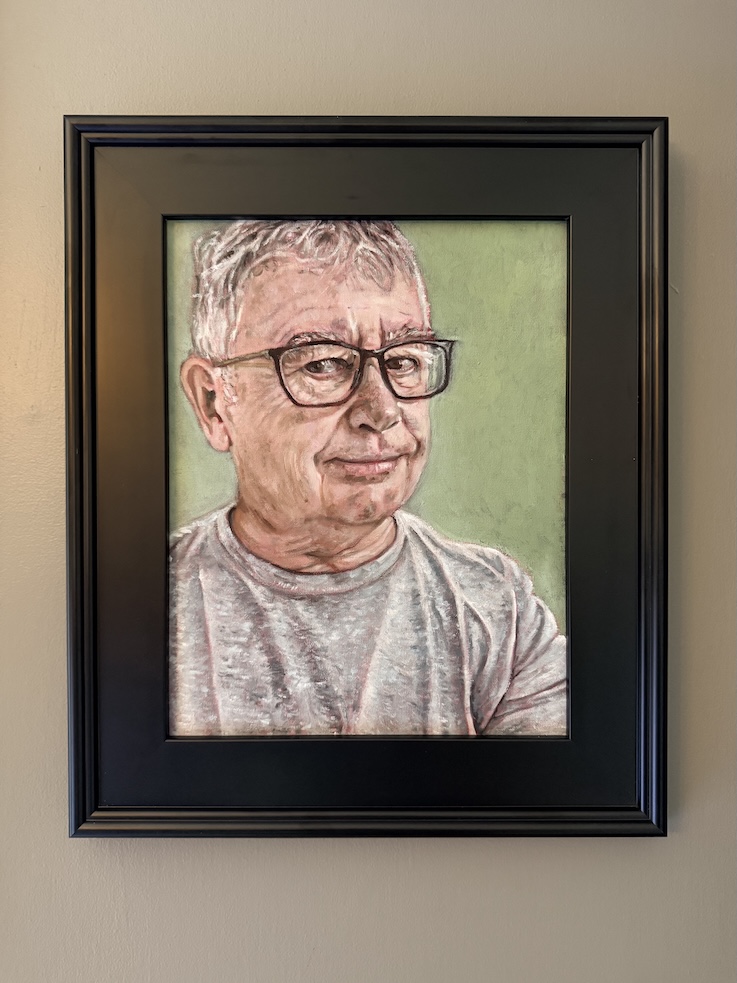
    This week another piece of mine goes on display at the Station Gallery in Whitby. My third self portrait study will be part of Rare Form, the 33rd Annual Juried Exhibition at the galllery. It is one of its best attended shows of the year. I signed my show contract yesterday. Originally scheduled to begin on Monday, my understanding is Rare Form is now open this weekend. The official opening — including announcement of competition winners — will not be until December 17th from 7 – 9 pm at the Gallery. The show runs to January 25, 2026. Please come if you can.

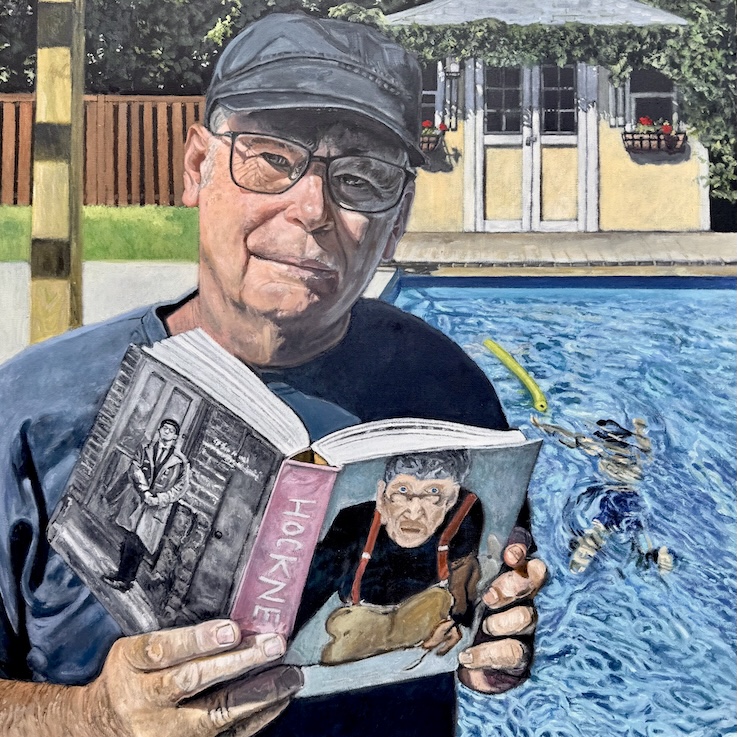
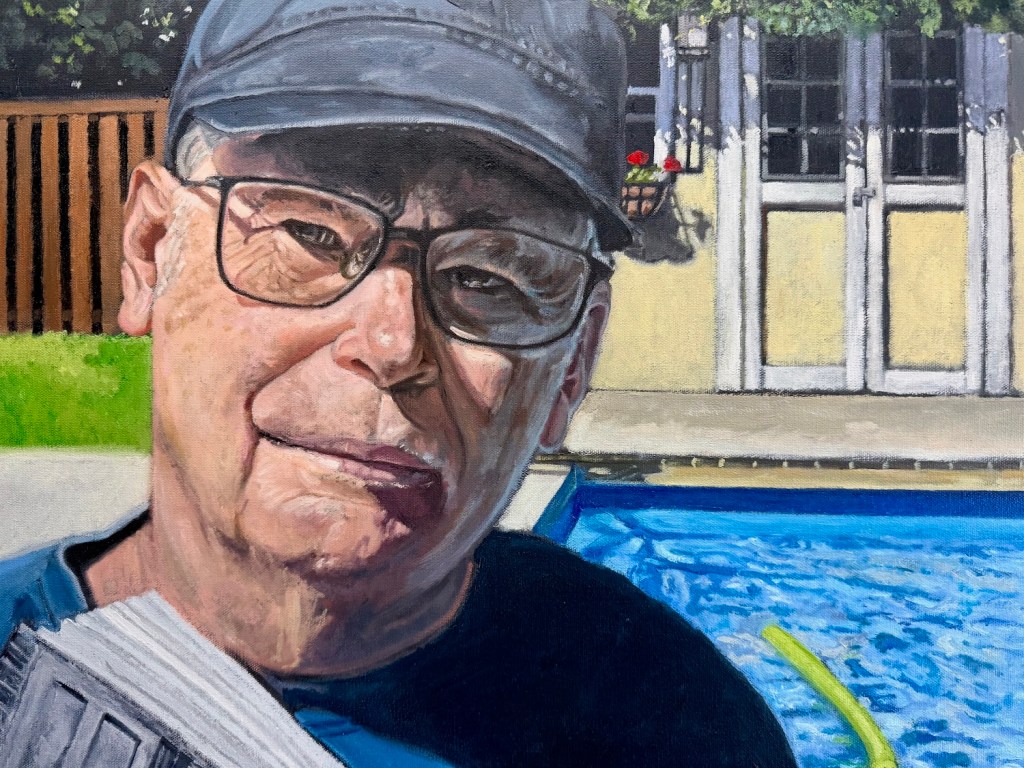
    So how did my self-portrait become part of this? I originally thought the theme was a different one, having downloaded a form that turned out to be old internet flotsam for the same show. I had completed the painting on the different theme, then realized the mistake I had made, not noticing the due date for entry on the form was in 2023. Whoops. At the time I was working on a series of self-portraits and thought about the fact that they better fit the show’s actual theme. How many times have I been told that I’m in “rare form” today? Okay, that’s mostly for snappy retorts, but hey. What could be rarer than, well… us? Thanks to my neighbour Jeff who took the painting down to the gallery when I was away in the UK.

    It has been a rush since I’ve been back from Scotland. The first priority was to complete our “book,” kind of an annual report/visual diary that goes out to family and friends around this time of year. I’ve been doing these books for 17 years, the last 15 printed through Blurb, an on-line printer based in San Francisco (although the printing appears to have taken place all over the US judging from the shipping details). Given the orange menace’s economic attacks on this country, I couldn’t in good conscience continue to print south of the border. With the exchange on the dollar, it was particularly killing me. I ended up finding a UK-based printer that has a plant here in the Greater Toronto Area. However, that did mean finding a new software that would work (Blurb’s is proprietary), as well as working out all the details on how the new printer (Mixam) would like to receive the material. That was a steep learning curve, especially after 15 years doing the same process. It didn’t help that I came back from the UK with more than 1300 photos which had to be downloaded and adjusted for print. I ended up doing more than half of the 248-page book in about a week and a half, including writing, paste up, selecting images, and of course, proofreading and uploading it.

    Cherry Street (Halifax) (1987) 24″ x 30″ Oil on Canvas

    In recent years we have started also doing Christmas cards using my paintings on the covers. I did have another painting in mind for this year, but it is still on the easel, is very wet right now, and may need a bit more work before it gets submitted December 7th to another juried group show in Toronto. Sooooo… I took a look at what else I had and decided to go back to the first piece I did after I graduated from art school in 1987. A winter scene, I liked it for what wasn’t in the picture — a large tree out of view that is throwing a very visible shadow against the wall of a house. I passed that house (Cherry and Robie) regularly while living in Halifax, Nova Scotia. I applied the paint quite thickly, determined to shed my tight painting style (something I’m still attempting to do nearly 40 years later). All this time later the painting still hangs above our fireplace. The cards are expected back on Tuesday.

    With the cards and the books underway, I have been back in the studio, not only on the aforementioned piece for the January show, but several others that I had started prior to travelling to the UK. After about an eight week break, it felt weird being back on them, but the brushes eventually found their way. I’m hoping to have all three done before the end of the year, although it may be a challenge given all the seasonal activity in the run up to the holiday season. The Highland Coo Christmas tree ornament has been barely unpacked! I also have a lot of material fresh in my mind from our recent trip to the UK that is calling out to me. “Rick, Rick… don’t forget about me!”

  • Looking at rich people’s stuff

    When we first arrived at Glasgow’s Burrell Collection we got offered a tour before even taking stock of where we were. Given the somewhat disorientating layout of the building, it turned out to be a good idea, although I was somewhat distracted at the time by the medieval players off in one corner of the lobby (see photo above). The guide began by emphasizing that this was a “collection,” and not a traditional gallery or museum, per se. It reflects the collecting habits of one person, albeit one very rich person. Like many of these “collections,” it tends to be a bit quirky despite little doubt that Burrell would have received the advice of curators and gallerists in putting together this pile. The “Souvenir Guide” states that Burrell had developed an interest in art as a child: “He used his wealth to steadily build his collection, quickly surpassing his local contemporaries in terms of the quantity and quality of his artworks and firmly established an international reputation as a collector of good taste and judgment.” The initial donation in 1944 included 6,000 items.

    Sir William Burrell made his money from the shipping business, of which another Glasgow institution — the Kelvingrove Art Gallery and Museum — reminds us that much of that wealth derived from not treating his ship crews very well. That seemed less of an issue than some of the other great benefactors of art and culture in the city, some of whom were directly involved in the business of slavery. According to his Wiki biography, much of Burrell’s wealth came from selling his ships during World War I for much more than what he had paid for them. In other words, he became very rich by becoming a war profiteer.

    But I suppose its water under the bridge — it is the public that now has his stuff.

    Today the collection is administered by the City of Glasgow, and as such, is free to visit. There is no admission charge, like many of the public galleries in Scotland.

    The collection is an odd assortment of art and artifacts. Burrell loved Edgar Degas’ work and collected a lot of it. Unfortunately for us, they had just featured a Degas retrospective so many of those paintings were now off display. The rooms of painting also including works by Cezanne, Manet, Monet, Sisley, Whistler, Fantin-Latour, Gauguin, Boudin as well as then-contemporary work by the Glasgow Boys, including S.J. Peploe, George Henry and John Lavery. Then there were more historic pieces, including a Rembrandt self portrait, as well as more minor works by Courbet, Hogarth, and Hals. Almost every art gallery and museum has much more in its collection that it can reasonably display, so its no surprise that the building housing the Burrell Collection also makes sure to hold back some of that collection for rotation and also for restoration and maintenance. It makes a show of it in the lower level, a film about the collection giving way to a view of the storerooms by the end.

    The collection is a bit of this and that, from the medieval armour and weaponry to furnishings, stained glass, carpets, ceramics and tapestries going back to antiquity. Our guide showed us a portal taken from Hornby Castle in Yorkshire, noting that Burrell had got it at a bargain from the collection of William Randolph Hearst. This massive stone portal has been to America and back. We also got a look at a headboard that once belonged to Anne Boleyn — a rarity given Henry VIII destroyed many of her belongings after her execution. Perhaps it was retained because it included a carving of Henry on the left side with a rather noticeable codpiece.

    Corner of a headboard that once belonged to Ann Boleyn. On the left side is a carving of Henry VIII.

    But that is the ultimate problem with these “collections” — once the benefactor has passed, they mostly become static collections, or at the very least, collections limited to their “vision.” Depending on the conditions set by the benefactor, that means lesser works or works that haven’t passed the test of time can remain in the collection. However, we did notice that there have been some new acquisitions since Burrell passed away, including the Warwick Vase, estimated to have been originally made in Italy in the 2nd Century CE. The Burrell hadn’t acquired it until 1979 (more than two decades after Burrell’s death), although it does seem to still fit within Burrell’s vision for the collection. The building didn’t open to the public until 1983, the construction supported by significant public money.

    It does, of course, raise the issue of who decides what art has value to a society? Is it the ultra-wealthy who call the shots, or can this be mediated by other players, including artists, gallerists, academics, and curators. Where does the public come in, especially in an environment where art education has been in decline?

    These collections sometimes feel like cultural tombs. And unlike many contemporary cultural institutions, it is not in a position to easily address changes in public sentiment, such as the addition of works by women or people of colour.

    One of the gallery rooms at the Burrell Collection.

    The day we chose to visit turned out to be a good one. There were a lot of people present. There were actors sword fighting as well as musicians in medieval dress playing to a group of dancers. There appeared to be a lot of docents giving tours. It did present challenges in the cafeteria, where one must find a table first, then go to a counter to order your meal, give them your table number, then return to have it delivered. It means both of you have to figure out what you want, find a table, then have the other order and pay for the food. For two people it worked out, but it would be confounding if you were visiting the collection alone.

    On the walk to the Burrell through the beautiful Pollak Park, we spoke to an American woman from Chicago who lamented what was happening in her country. Of Hispanic descent, she was worried for her family amid the ICE raids. She also noted the growing intolerance here in the UK, especially with the rise of Nigel Farage. These are frightening times.

    Thinking about this idea of who curates what we get to see, I experienced a bit of that while out shopping yesterday. When I was in the UK I saw that David Byrne (of Talking Heads fame) had a new LP out. I didn’t want to drag it back from Britain, instead preferring to buy it locally after I returned.

    When I visited the mall yesterday I stopped by a good-sized record store tucked into the far end of the building. They didn’t have it. In fact, they didn’t have much in the way of new releases at all. What made it harder was that it was difficult to distinguish the new from the overwhelming number of reissues of older material that they chose to highlight on their shelves. I checked for some other new titles I was interested in. None of them were there. But you could get a reissue of Who Are You, an album I bought when I was in my early twenties. There were a lot of copies.

    I found that disturbing, especially having once worked in the record retail industry in the 1970s. Back then all the new stuff was highlighted at the front of the store. There was a lot of it. Magazines like Uncut and Mojo have pages of new material every month. Problem is, you won’t find much of it in a local record store. In the end, and with much reluctance, I ordered it on-line.

  • Inspiration and intimidation

    Recently I found a copy of Kate Bryan’s new book “How To Art” while in Waterstone’s in Glasgow. It turns out, the signed copy also had an extra chapter on Banksy that was exclusive to the UK chain store. What surprised me about the book is both how accessible it was and the wide audience it intended to address, including everything from how to introduce your children to art to how artists themselves can find inspiration, particularly when stuck.

    For those who are unfamiliar with Bryan, she is one of the three judges on Sky Arts Artist of the Year series, including both Landscape Artist of the Year and Portrait Artist of the Year. In the show she is billed as an art historian, but in reality she has worked in both and private and public sphere within the art world. On the dust jacket its says that since 2016 she has been curator of SOHO House’s art collection, which has about 10,000 artworks, none of them mine.

    It so happened that one of my intentions of being in Scotland — aside from utilizing a flat my sister had generously offered to us for the duration — was to recharge my art activities. I find travel opens up news ways of seeing for me, especially when it involves visiting galleries and museums, or in at least one instance, a specific curated collection. More on that in coming posts.

    While I’m not stuck, per se, I was very interested in Bryan’s views on inspiration. She notes that some artists may visit their favorite art gallery to recharge, but that it may compound one’s frustration in some cases. She notes UK artist Charming Baker, who she says once told her that “he feels physically sick if he sees a work by an Old Master while he is struggling with his own painting.”

    I fit somewhere in between. I find visiting galleries wets my appetites to get back into my studio, but it is also intimidating and cuts to one’s confidence when faced with a masterpiece. Making art is a trick of confidence, for sure. When a work of art knocks me off my feet, my initial reaction is to try and figure out why. Then I cry that I’ll never be that good. Usually in that order.

    The National Gallery of Scotland is in fact dispersed throughout a number of locations. This seems to be a thing in Britain — big names like the Tate and the V&A have spread throughout the country. In Edinburgh alone, there is the main location close to Waverly Station, then there is the National Portrait Gallery up the hill, and if you head into Edinburgh’s new town, there are two modern galleries that also belong to the National.

    On this trip we did make it back to the National Portrait Gallery (we had last been there in 2022), if only to look at the new work in the contemporary portrait galleries, including recent winners of the Portrait Artist of the Year competitions. I think the National has figured out that these portraits do draw in a certain audience. Then we walked down the hill to get to the main location, which houses an ample cross-section of Scottish art on the lower level, and a generous survey of international historical work on the upper floors, including such diverse icons as Tintoretto, Titian, Rembrandt, Rubens, Botticelli, Velazquez, Goya, and Van Dyck, to name a few. For a country of about six million people, it really has an impressive collection.

    It was on the upper floors we turned a corner and were confronted with a painting I had long admired in books but never seen in person — John Singer Sargent’s 1892 portrait of Gertrude Vernon, Lady Agnew of Lochnaw. Her direct stare froze us in our tracks. Singer Sargent has this way of creating incredible presence in his work yet often maintains deceptively loose brush work. You feel confronted by the image first, the paint secondarily there to remind you of the magic that the artist has rendered.

    Gertrude Vernon, Lady Agnew of Lochnaw (1892) by John Singer Sargent. Collection of the National Gallery of Scotland, Edinburgh.

    This portrait for Singer Sargent was his comeback, the one that made him acceptable to society after the scandal his painting of Madame X created while exhibited at the Paris Salon. Wiki describes Madame X quite well: “Sargent shows a woman posing in a black satin dress with jewel straps, a dress that reveals and hides at the same time.” Critics found it to be vulgar and oversexual. Curiously, Madame X was not a commission, but rather a painting Singer Sargent chose to do.

    While I had seen Gertrude Vernon’s portrait in reproduction many times before, it was a very different experience seeing it in person. While the trappings are very much of the time, it still feels very current, as if she sat there waiting for you to enter the gallery. In a room full of impressionist paintings, it was remarkable in-so-much as it overwhelmingly commanded attention over such crowd-pleasing competition from the normally more popular French Masters.

    It also strikes me both how formal and how casual the piece is. The sitter looks relaxed, her legs crossed and her body reposed to one side of the chair, revealing the magnificently painted fabric. While Madame X was considered overtly sexual, this painting was described instead as beguiling.

    It led to a flood of commissions for Singer Sargent, or what fellow artist Walter Sickert described as “Sargentology.”

    Clearly Singer Sargent brought a lot of skill to this work, in both the composition, the tone, the colour and the paint handling. But I later wondered how much this was a collaborative work? Without such a sitter, considered a beauty in her time, would society have fallen over itself in the same way? How much of her pose was Sargent, and how much was her own? The pose can determine much about the personality of the sitter. And let’s not forget that direct hypnotic gaze.

    The gallery’s catalogue notes that the cost of sustaining her “celebrity with style” led Vernon to sell the painting in 1925 to the National Gallery of Scotland, where it remains a hundred years later. It’s sad she couldn’t keep it.

    The gallery has hung the portrait high, making it difficult to fully see given the lighting reflecting off the varnish. Visiting the other salons in the gallery, its obvious they have hung the works according to the period in which they emerged — often stacked up to the ceiling rather than the more modern approach of hanging everything at eye level.

    I’m back from my travels, and it seems overwhelming the list of art activities on the agenda. My neighbour kindly took over a painting of mine to a nearby gallery for entry to a juried show in December. They’ll make a decision whether I’m in or out by November 17th. Meanwhile, while I was in Scotland I learned that I have been accepted as a guest artist in the Scugog Studio tour at the beginning of May. There is also a third opportunity in Toronto for another juried show in January based on the colour pink. The deadline is December 7th for entry. That’s not much time to pull a piece together, especially while recovering from jet lag.

    I briefly went into my studio yesterday to drop off a new pallette — the last one looking like one of those grade school topographic maps with the protruding mountains. I was recently in a local gallery that was selling used paint-covered artist pallettes,. I now wonder if I should be just chucking these out or whether to wait and see if there is any interest? The gallery owner told me that people buy them and hang them on the wall next to their collection. Really? How odd.

    Being in the studio I reminded myself of the work that I just got started on before heading to Scotland on October 2nd. That’s quite a gap. As those who know me already understand, I usually work on four and sometimes five paintings at a time, rotating them daily, sometimes having two canvases on the easel in the same day. With a short deadline for the pink painting, it may take priority, although I am eager to get stuck in.

    More to say about my art experiences in Scotland in the coming posts.

    Meanwhile, if you want to peruse my most recent work, click here.